

Marketing leaders are entering 2027 planning with a familiar problem: they are expected to deliver AI-driven growth and transformation, but their budgets are not growing to match. Gartner’s 2026 CMO Spend Survey puts numbers on that tension, and they offer a practical framework for anyone building next year’s marketing plan.
What Gartner found
The survey was fielded from January to March 2026 among 401 CMOs and senior marketing leaders in North America, the United Kingdom and Europe, most of them at companies with more than $1 billion in annual revenue. Its headline findings, published in May and June 2026:
- Budgets are flat. Marketing budgets averaged 7.8% of company revenue in 2026, up only slightly from 7.7% in 2025. Gartner notes that budgets have been on a plateau since 2022 and that today’s average is 18% lower than the mean allocation four years ago.
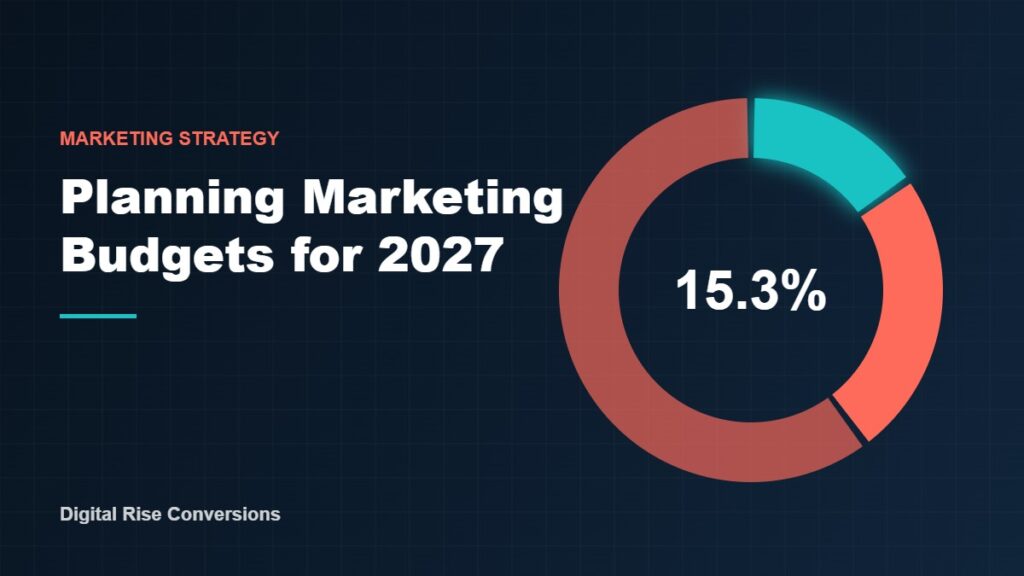
- AI has a real budget line. CMOs allocate an average of 15.3% of their marketing budgets to AI initiatives.
- Readiness lags ambition. Only 30% of CMOs report mature or fully developed capabilities to scale AI.
- AI-ready teams get more. The more AI-ready marketing organisations allocate 21.3% of their budgets to AI, and those with optimised AI programmes receive a higher share of company revenue for marketing, averaging 8.9%.
- Spend is shifting to acquisition. Awareness and conversion now account for 62.6% of media spend, about 10% more than in 2024, as CMOs prioritise customer acquisition over loyalty and retention.
- People still cost more, not less. Labor rose to 24.5% of marketing budgets in 2026 from 21.9% in 2025, according to Marketing Dive’s coverage.
- Martech is changing shape. 62% of respondents planned to invest more in marketing technology, with a move toward consumption-based (usage-based) pricing, Chief Marketer reported.
Three tensions behind the numbers
1. AI investment without the operating model to use it
Spending 15% of a budget on AI while 70% of organisations say they cannot scale it suggests a lot of money is going into tools that are not yet changing how work gets done. Gartner attributes much of the gap to internal processes rather than technology.
2. Automation, yet rising labor costs
The growing labor share contradicts the simple story that AI will shrink marketing teams. Gartner’s own reading is that AI value depends on people, skills and execution. Specialist roles in data, marketing operations and AI workflow design are expensive, and they are the ones that turn tools into results.
3. Acquisition over retention
Moving budget toward awareness and conversion makes sense when CEOs want growth. But acquisition channels are also where costs rise fastest and where AI-driven search is changing how customers discover brands. Under-investing in retention can make growth more expensive over time.
A 2027 planning framework based on the data
Step 1: Fund capability, not just licences
For every euro or dollar planned for AI tools, budget for the people and process changes needed to use them: training, workflow redesign, data clean-up and governance. The difference between average and AI-ready teams in Gartner’s data is about readiness, not appetite.
Step 2: Make deliberate cuts
Gartner advises eliminating low-value legacy spend and automating routine work to free up capital. Review recurring costs line by line: overlapping tools, reports nobody reads, agency retainers for work that can now be done in-house.
Step 3: Rebalance channels for AI-mediated discovery
Customers increasingly research through AI assistants and AI search features. Plan budget for content and data that AI systems can cite, and for testing new paid formats such as ChatGPT Ads. Our analysis of AI-assisted holiday shopping shows why this matters for conversion, not just awareness.
Step 4: Protect a retention floor
Set a minimum share of budget for existing customers, such as lifecycle email, loyalty, onboarding and service content, so that acquisition pressure does not erode the cheapest revenue source.
Step 5: Plan for usage-based costs
As martech and AI pricing shifts toward consumption, costs scale with activity. Build monthly monitoring and caps into your plan, and model scenarios where prices change mid-year, as they frequently do for AI models.
Applying this outside large enterprises
Gartner’s sample is dominated by large companies in North America and Europe. Smaller businesses and teams in other regions face different constraints, often with smaller budgets but fewer legacy systems. The principles still apply: invest in skills alongside tools, cut low-value spend deliberately, and measure AI initiatives against business outcomes rather than adoption.
Conclusion
The 2026 CMO Spend Survey describes a function under pressure to do more with the same money. The organisations pulling ahead are not those buying the most AI, but those building the skills, processes and measurement to make it work. For 2027 plans, that means treating AI as an operating model change with a budget to match, not just another line in the software budget.
Sources
- Gartner, 2026 CMO Spend Survey press release (May 11, 2026)
- Gartner, CMO Spend in 2026: Redefining Marketing Investment Under Constraint
- Gartner, Awareness and Conversion Account for 62.6% of Total Media Spend (June 8, 2026)
- Marketing Dive, Customer acquisition media spend accelerates amid rush to AI
- Chief Marketer, Budgets reflect increase in consumption-based martech