On November 10, 2026, Google made Gemini 4 Carbon available to developers, businesses, scientists and its highest-paying consumer subscribers. Google positions Carbon as its most capable model for long, multi-step “agentic” work, cybersecurity, software engineering and complex knowledge work. Most coverage has focused on benchmarks and cybersecurity. This article looks at a narrower question: what does Carbon change for marketing and digital teams, and what should they do before its introductory pricing ends on November 30?
What Google released, and to whom
Google first announced Carbon on October 28 and gave it to a small group of cybersecurity defenders through its Fairwind Program. Two weeks later, the general availability announcement opened access more widely:
- Developers and enterprises: via the Gemini API in Google AI Studio and through Gemini for business, for paying customers. The model is not available on the free API tier.
- Consumers: Google AI Ultra subscribers can use it in the Gemini app, in AI Mode in Google Search and in Google Antigravity, Google’s agent-first development platform.
- Cyber defenders: continue to apply through the Fairwind Program.
Carbon sits alongside Gemini 4 Argon, which remains a separate model in Google’s line-up.
Pricing: a deadline worth noting
Google set an introductory API price of $2 per million input tokens and $10 per million output tokens, matching Gemini 4 Argon. After November 30, 2026, the price doubles to $4 per million input tokens and $20 per million output tokens. Teams evaluating Carbon for high-volume work, such as content analysis, product feed enrichment or customer-service summarisation, should run their cost tests now and model the post-November price, not the introductory one.
What Google says Carbon is good at
Google’s announcement emphasises long-horizon tasks: work where the model must plan, use tools and keep track of many steps. For legal, finance and business operations, Google says Carbon combines visual understanding, reasoning and broad information retrieval to draw grounded insights from dense documents and large datasets, and that it follows strict structures and formats to produce spreadsheets, presentations and reports.
Google also reports first-place results on several benchmarks, including CursorBench 4.0. These are vendor-reported figures; independent evaluation is still limited, so treat them as directional.
What it means for marketing teams
1. Reporting and analysis are the most realistic first use
The capability Google highlights most, turning large and messy data into structured reports and decks, maps directly to marketing work: monthly performance reports, competitor reviews, campaign post-mortems and research summaries. These are tasks where a model that reliably follows a template saves real hours. The human role shifts to checking numbers and interpreting them.
2. Agentic workflows need guardrails
Carbon is designed to run multi-step tasks, and Google’s Antigravity platform supports teams of agents working together. In marketing, that could mean an agent that pulls data, drafts a report and prepares a presentation. Before connecting any model to ad accounts, CRMs or publishing tools, define what it may read, what it may change and where a human must approve. The time saved is lost quickly if an agent changes a live campaign incorrectly.
3. AI Mode gets a stronger engine, for some users
Because Carbon is available in AI Mode for Ultra subscribers, some of the most engaged Google users now get answers from a more capable model. For brands, that reinforces the need to publish precise, well-structured information that AI systems can cite accurately. We cover the interface changes in our article on Google’s AI Mode sidebar and recent tests.
4. Model choice is becoming a procurement decision
Marketing teams now choose between frequently updated models from Google, OpenAI, Anthropic and open-weight providers, with prices that change within weeks. Building workflows that can switch models, and testing them on your own tasks rather than on public benchmarks, protects you from lock-in and price changes like the one arriving on December 1.
A simple evaluation plan
- Pick three real tasks, for example a monthly SEO report from Search Console exports, a competitor messaging comparison, and a campaign summary deck.
- Run them on Carbon and on the model you use today, using identical inputs and instructions.
- Score accuracy first: check every figure against the source data. Then score structure, usefulness and time saved.
- Calculate cost at the post-November price for your expected monthly volume.
- Decide where a human stays in the loop before any wider rollout.
Limits to keep in mind
- Benchmark leadership claims are vendor-reported.
- Consumer access is restricted to the Ultra plan, so most of your customers will not see Carbon-powered answers yet.
- Strong reasoning does not remove the risk of incorrect figures; review remains essential.
- Budget planning should assume continued price changes across providers. For wider context on how AI is changing marketing budgets, see our analysis of CMO budgets and AI investment.
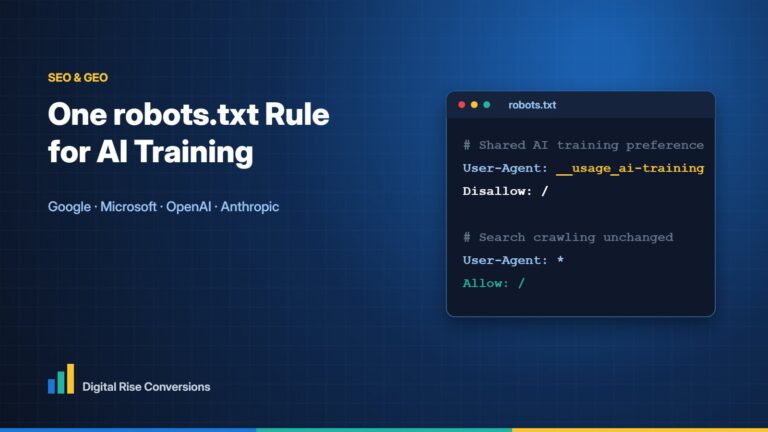
Publishers deciding whether their content should help train or ground models like Gemini have a new option on the way: a shared robots.txt signal that Google plans to map to Google-Extended. See how the shared AI training opt-out works and what it means for Gemini.
Conclusion
Gemini 4 Carbon is aimed first at developers, enterprises and specialists, but its strengths in structured reports, document analysis and multi-step work are directly relevant to marketing operations. The sensible move is a short, controlled test on real tasks, costed at the post-introductory price, with clear rules on what any agent is allowed to do.
Sources
- Google, Gemini 4 Carbon is now available (Nov 10, 2026)
- Google, Gemini 4 Carbon for developers
- 9to5Google, Google announces Gemini 4 Carbon (Oct 28, 2026)
- Digital Trends, Google’s Gemini 4 Carbon is now available
- AI Weekly, pricing after November 30, 2026