Keeping a website’s content out of generative AI training has meant writing a separate rule for each company: GPTBot for OpenAI, Google-Extended for Google, and the NoArchive and NoCache tags for Microsoft. Miss one, and that provider could still use your pages for training.
On October 30, 2026, Google, Microsoft and OpenAI each said they will honor a single robots.txt instruction that expresses an AI training preference to every participating provider at once, and Anthropic’s Kevin Kelley submitted the Internet-Draft that defines it. Nothing changes overnight. The proposal has no formal standing at the IETF, and most companies will only start reading it in 2027. But it changes how publishers, brands and SEO teams should plan their AI controls. Here is what was announced, how the signal works and what it will not do.
What was announced
- Google: in a Search Central blog post by John Mueller, Google said it intends to support the shared signal in early 2027. When a site uses it to opt out of training, Google plans to treat that as a Google-Extended disallow, unless the site sets Google-Extended explicitly (Search Engine Roundtable).
- Microsoft: Bing is adopting the shared AI Training preference and adding separate page-level controls for AI grounding. Temporary grounding controls arrive in Bing Webmaster Tools on December 15, 2026, and Microsoft will start honoring the new preferences on February 1, 2027 (Search Engine Roundtable).
- OpenAI: OpenAI said it will honor the common signal for foundational generative AI training, as a voluntary effort alongside other providers.
- Anthropic: the draft’s author says Anthropic has already started implementing support.
Meta, Amazon and Apple made no commitments in these announcements, according to PPC Land.
How the __usage_ai-training token works
The signal is defined in an Internet-Draft titled Machine-Readable Training Preference Signal. Version 01 was published on November 16, 2026. It is an individual draft without IETF endorsement, and it expires on May 20, 2027 unless it is updated.
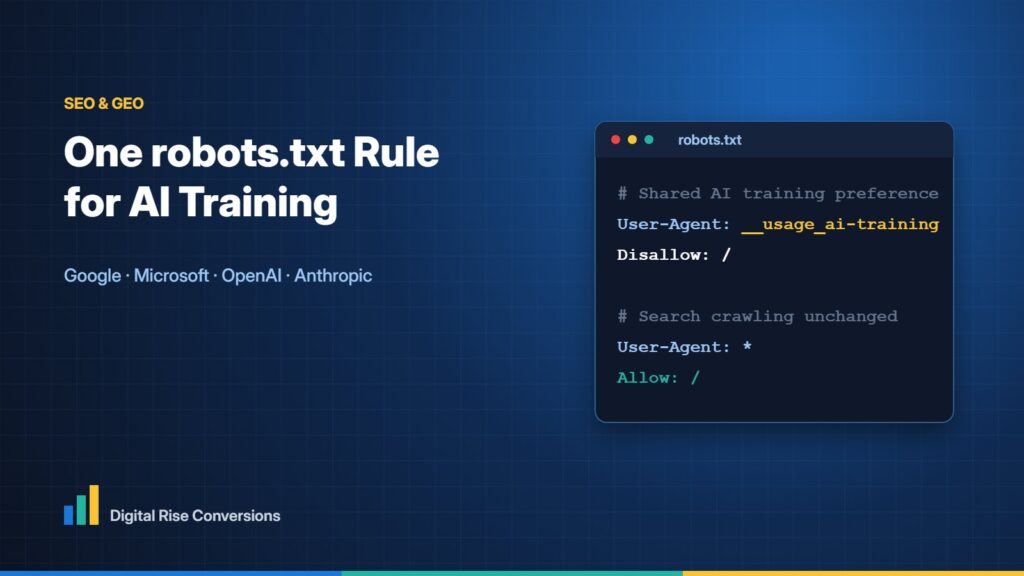
The draft uses the AI Preferences working group’s definition of AI training: using an asset to modify the learned parameters of a generative AI model. Instead of naming a crawler, it introduces a policy token, __usage_ai-training, that sits in the User-Agent line of robots.txt and reuses the file’s familiar Allow and Disallow path rules.
To express a preference against AI training for the whole site:
User-Agent: __usage_ai-training
Disallow: /
To opt out a single section, such as a premium content area:
User-Agent: __usage_ai-training
Disallow: /premium/
The draft’s own example opts out everything except a press kit, which the site is happy to see used:
User-Agent: __usage_ai-training
Disallow: /
Allow: /press-kit/
A few rules are easy to get wrong:
- Wildcards do not count. A
User-Agent: *group must not be read as matching the token. If no group names__usage_ai-training, no preference is expressed. - It is not a crawling directive. The token describes how content may be used, not whether it may be fetched. Blocking a crawler still requires its own user-agent rules.
- Specific beats general. More specific expressions take precedence, and private licensing agreements may override the stated preference.
What the signal does not change
The shared token is narrow by design. Understanding its limits matters more than the syntax.
- Search rankings: neither Google nor Bing says the preference affects traditional search results.
- Google’s AI search features: AI Overviews and AI Mode are not controlled by the training token. Google manages them with Googlebot rules and the Search generative AI control in Search Console, which Google says it rolled out to all websites worldwide on August 31, 2026. That control, in turn, does not affect training.
- Grounding at Google: Google-Extended covers both training and grounding in Gemini Apps and Vertex AI, and Google has no separate grounding token. A shared-token opt-out will therefore also remove grounding in those products, unless you add an explicit Google-Extended rule. That matters if you want your content to keep appearing in Gemini, which we looked at in our article on Gemini 4 Carbon.
- Grounding at Microsoft: the robots.txt token covers only training. Grounding preferences are set page by page with meta tags or HTTP headers.
- Content collected earlier: the draft applies the preference in effect when content was retrieved. It does not address material collected before you set it.
- Enforcement: the signal is voluntary and the draft has no enforcement mechanism.
How to prepare
1. Decide your policy before writing rules
Separate three questions: do you want your content used to train AI models, do you want it used to ground AI answers that can cite and link to you, and do you want it in search results? Blocking grounding usually reduces visibility in AI answers, so many brands will want to allow it even if they refuse training. Publishers with licensing interests may decide differently.
2. Inventory your existing controls
List every AI-related rule in robots.txt and in page-level tags today, such as GPTBot, Google-Extended and NoArchive. Keep them. Providers have not all started reading the shared token, and company-specific rules will continue to work alongside it.
3. Add the shared token when your policy is clear
Adding the token now does no harm and documents your preference for the providers that adopt it. Test the file after every change, because a syntax error in robots.txt can affect crawling far beyond AI.
4. Act before Microsoft’s March 2027 deadline
If you rely on NoArchive or NoCache to limit Bing’s AI use, Microsoft says those tags will no longer count as training or grounding preferences after March 1, 2027. Plan to publish the new page-level preferences, and use the temporary controls in Bing Webmaster Tools if you need more time.
5. Review your choices regularly
The draft, the provider timelines and the trade-offs will keep moving through 2027. Put a quarterly review on the calendar, and track AI referrals and citations so you can see the effect of your settings. First-party data such as the ChatGPT Business Hub and Bing’s AI Performance report make that easier than it was a year ago.
Conclusion
A single robots.txt token for AI training would remove one of the most frustrating parts of managing AI controls: keeping up with a different rule for every company. The commitments from Google, Microsoft, OpenAI and Anthropic make it likely to become the default way to state a training preference. It is still a draft, though, and it only covers training. Decide your policy on training, grounding and search separately, keep your existing rules in place, and treat the shared token as an addition rather than a replacement.
Have a question about this article or spotted something we should update? Contact our team, and read our editorial policy.
Related reading
- ChatGPT Business Hub: What OpenAI’s New Mention and Click Data Means for Brands
- Google AI Mode’s Mixed Signals: A New Homepage Sidebar While Tests Remove It From Results
- Google’s November 2026 Core Update: What Changed and How to Measure It
- Browse more coverage in SEO & GEO
Sources
- IETF Datatracker, Machine-Readable Training Preference Signal (draft-kelley-aipref-training-preference-signal)
- OpenAI, Making it easier for websites to express AI training preferences (October 30, 2026)
- Google Search Console Help, Search generative AI control
- Search Engine Roundtable, Google to support a shared AI training control (October 30, 2026)
- Search Engine Roundtable, Microsoft Bing New AI Controls With AI Training From AI Search Grounding (October 30, 2026)
- PPC Land, Google, Microsoft, OpenAI and Anthropic back one AI training opt-out