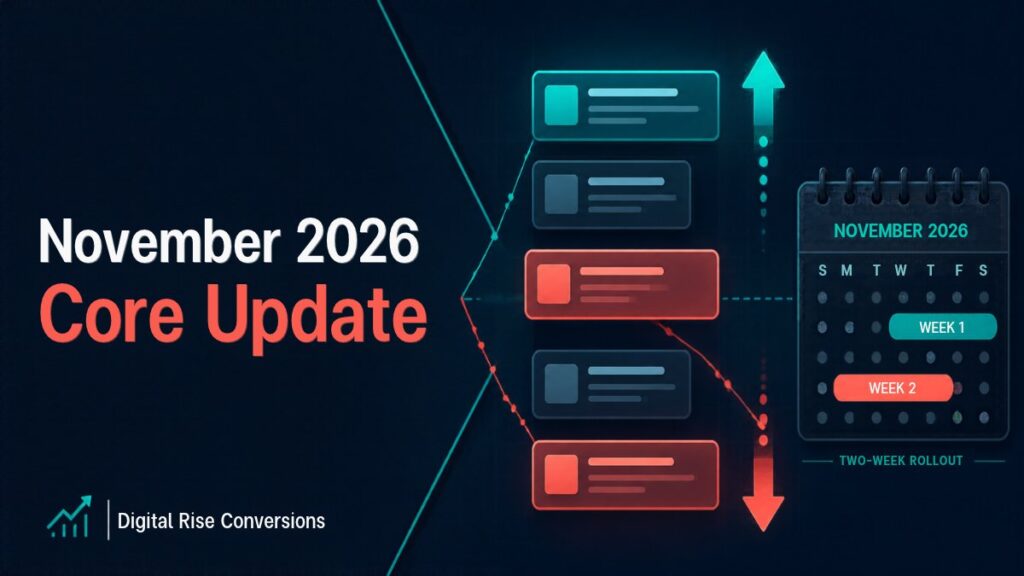
Google started rolling out its November 2026 core update on November 10. It is the third broad core update of the year, it applies to every language and country, and Google said the rollout could take up to two weeks. Yet the update arrived with less noise than usual, partly because several rank-tracking tools have struggled to monitor Google’s results. That makes it a useful moment to revisit what a core update is, what Google actually said, and how to measure impact without drawing the wrong conclusions.
What Google announced
The update appeared on the Google Search Status Dashboard at 10:06 a.m. Pacific time on November 10, 2026. Google described it as a regular update intended to better surface relevant, satisfying content for searchers from all types of sites. It gave no specific targets.
Some details stand out:
- Timing: it follows core updates in March and May 2026, making it the third broad core update of the year.
- Volume of updates: Search Engine Journal counted it as the eighth ranking update listed on the dashboard in 2026, after a run of spam updates in June, August and September (the September spam update ran from September 24 to October 8).
- Channel: Google announced it through the dashboard and LinkedIn rather than its usual post on X, according to Rank Math’s tracking.
- Duration: “up to two weeks” places the expected end around November 24, right before the U.S. Thanksgiving and Black Friday period.
Why this update felt quieter
Search Engine Roundtable reported that discussion in SEO communities was more muted than for most core updates, and suggested one reason: several third-party tracking tools have had difficulty monitoring Google rankings. The same report noted that Search Console performance reporting had been lagging. Movement became more visible from around November 14.
This is an important caveat. When the tools that normally show “volatility” are partly blind, an absence of alarming charts does not mean an absence of change. Your own first-party data matters more than ever.
Core updates are not penalties
A core update is a broad change to Google’s ranking systems. It is not a manual action, and a drop does not mean your site broke a rule. Google’s documentation also states that it makes smaller core updates continuously that are not announced. The named updates are simply the larger ones.
When rankings fall after a core update, it usually means Google now judges other pages as more useful for those queries. The response is to improve content and experience, not to look for a single technical fix.
How to measure impact properly
1. Use a clean baseline
Google recommends waiting at least a week after an update has finished before comparing performance. For this update, a reasonable baseline is the week before the rollout, roughly November 3 to 9, compared with a full week after completion is confirmed on the Status Dashboard.
2. Separate seasonality from ranking change
This rollout overlaps with the busiest retail period of the year. Clicks for commercial queries rise and fall with shopping behaviour, not just rankings. Compare average position and impressions for stable queries, and compare against the same weeks of last year where possible.
3. Segment before you conclude
Look at changes by page type (articles, category pages, product pages), by query type (branded or non-branded) and by country. Google has just added new filters to the Search Analytics API, including branded queries and country and device filters, which make this kind of segmentation easier for teams that pull data programmatically.
4. Check whether AI features changed, not only blue links
A page can keep its ranking and still lose clicks if an AI Overview now answers the query more fully above it. Review the search results for your most important queries manually. Our article on Google’s latest AI Mode changes covers how the AI layer of Google Search keeps shifting.
If you lost visibility: what to review
- Content that exists for search engines, not readers. Pages written mainly to target a keyword, with little original information, are the most exposed to broad quality reassessments.
- Experience and evidence. Does the page show first-hand experience, original data, real examples or expert review? Pages that summarise what others already said have little to distinguish them.
- Intent match. Has the intent behind a query shifted? A query that used to return guides might now favour comparison pages, tools or forums.
- Site-wide quality signals. Large volumes of thin, outdated or duplicate pages can weigh on how a whole site is assessed.
- Page experience. Slow, cluttered or intrusive pages make it harder for strong content to perform.
Core updates in a world of AI answers
The November update arrives while Google is still experimenting with how AI Mode and AI Overviews are presented. For brands, this means SEO now has two goals: ranking in classic results and being cited or summarised accurately in generative answers, the practice often called generative engine optimization (GEO). The fundamentals overlap. Clear structure, original facts, consistent entity information and pages that answer specific questions well tend to help in both.
Paid visibility inside AI interfaces is also growing, as our analysis of ChatGPT Ads reaching a $1 billion run rate shows. Organic and paid strategies for AI search increasingly need to be planned together.
Conclusion
The November 2026 core update is a routine but significant reassessment of Google’s rankings, released at a time when measurement is harder than usual. Save a clean baseline, wait for Google to confirm completion, segment your data carefully and separate holiday seasonality from ranking changes. If you did lose ground, focus on making your best pages more original, more useful and more clearly matched to what searchers want now, rather than chasing quick fixes.
Sources
- Google, Search Status Dashboard
- Search Engine Journal, Google’s November 2026 Core Update Starts Rolling Out
- Search Engine Roundtable, Google November 2026 Core Update Ranking Flux (Nov 16, 2026)
- Search Engine Roundtable, Daily recap, Nov 16, 2026 (Search Analytics API filters)
- Rank Math, November 2026 Core Update tracking