In less than seven months, advertising inside ChatGPT went from a cautious U.S. test to a business that OpenAI says is running at more than $1 billion a year. For marketers, that is more than a revenue milestone for one company. It is the clearest sign yet that conversational interfaces are turning into a paid media channel with their own rules, formats and measurement problems.
This article explains how ChatGPT Ads developed during 2026, how the ads are matched to users, what early performance claims do and do not prove, and how marketing teams in Europe, the Middle East, North Africa and beyond should approach the channel now that self-serve buying is open in their markets.
From a U.S. pilot to a global ad platform
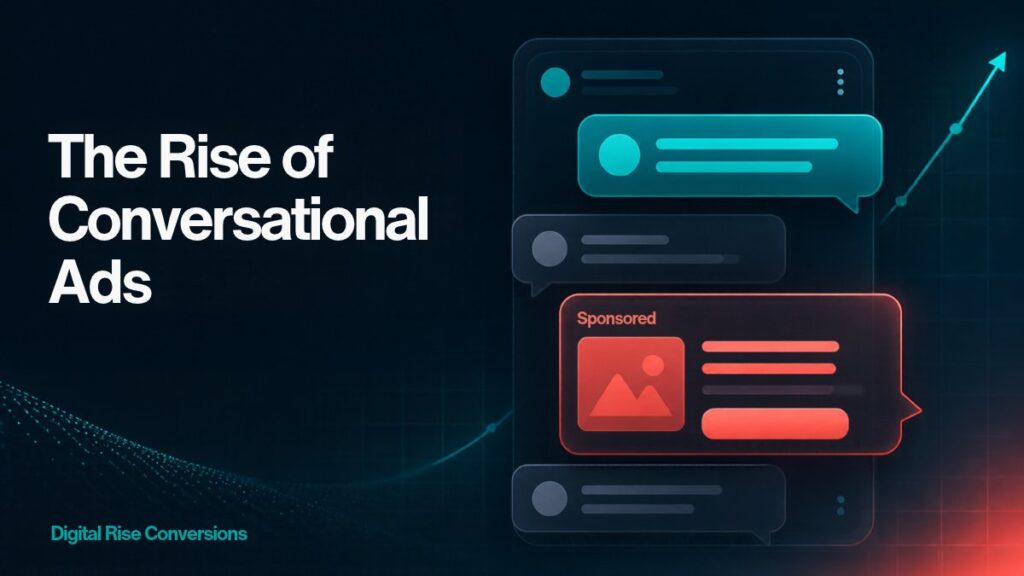
OpenAI began testing ads in ChatGPT on February 9, 2026, in the United States. The test covered logged-in adult users on the Free and Go tiers, while Plus, Pro, Business, Enterprise and Education subscribers were excluded. Ads appear as clearly labelled sponsored units, visually separated from the model’s answer.
The rollout then moved quickly:
- March 26, 2026: OpenAI reported that the pilot showed no impact on its consumer trust metrics and low ad dismissal rates, and said it would move to the next phase.
- May 7, 2026: the company announced plans to expand the pilot to the United Kingdom, Mexico, Brazil, Japan and South Korea.
- August 11, 2026: ChatGPT Ads launched in those five markets, with pilots planned for Canada, Australia and New Zealand.
- August 31, 2026: OpenAI said ChatGPT Ads had reached a $1 billion annualized revenue run rate in under 200 days, was used by tens of thousands of advertisers, and opened direct buying through Ads Manager across India, Europe, the Middle East and North Africa.
That last step matters for international brands. Until late August, most advertisers outside the pilot markets could only register interest. Self-serve access through Ads Manager turns the channel into something a regional e-commerce brand, a SaaS company in Dubai or an agency in Tunis can actually test with its own budget.
How ChatGPT decides which ad to show
According to OpenAI’s own description, the system matches ads submitted by advertisers with the topic of the current conversation. During the test phase, it also used a person’s past chats and past interactions with ads, and the company says that depending on country and user settings, context from the broader ChatGPT experience may be used. If several advertisers are eligible, the most relevant one to the conversation is shown first.
OpenAI repeats two principles in every update: ads do not influence the answers ChatGPT gives, and conversations are kept private from advertisers. Users who do not want ads can upgrade to a paid plan or, on the Free tier, opt out in exchange for fewer daily messages.
For marketers, this creates a targeting model unlike search or social:
- Intent is expressed in full sentences. A user does not type “CRM software”; they explain their team size, budget, existing tools and constraints. The ad sits next to that whole decision process.
- Context replaces keywords. There is no public keyword auction comparable to Google Ads. Relevance is judged on the conversation topic.
- Advertisers do not see the conversation. You will know that an ad was shown and clicked, not what the person asked. Creative and landing pages must work without knowing the exact question.
What the early performance claims tell us
In its August 31 announcement, OpenAI cited two examples: an e-commerce advertiser that achieved a 3x return on ad spend over 28 days, and a technology partner reporting that more than 80% of ad-driven ChatGPT traffic came from new customers.
Both figures are encouraging, but they are vendor-selected case studies, not independent benchmarks. They do not tell you the median result, the category mix, or how attribution was handled. The second figure is arguably the more interesting one: if conversational ads mainly reach people who have never visited your site, the channel may be better at acquisition than at retargeting, which is where much of the budget in mature channels currently goes.
Treat these numbers as a reason to run a controlled test, not as a forecast for your own account.
The wider shift: ads are moving into AI answers everywhere
ChatGPT is not alone. On November 19, 2026, Microsoft confirmed that ads are appearing in AI Overviews on Bing Search, according to Search Engine Roundtable. Google has been placing ads in and around AI-generated results for longer. The common direction is clear: wherever people now ask questions in natural language, a sponsored layer is being built next to the answer.
This has two consequences for budget planning. First, the old split between “search” and “social” budgets is becoming harder to defend, because AI assistants combine discovery, comparison and decision in one interface. Second, organic visibility inside AI answers and paid visibility next to them are becoming two sides of the same strategy. Our coverage of Google’s November 2026 core update and of Google’s latest AI Mode changes looks at the organic side of that equation.
What search interest shows
In Google Trends (worldwide, past 90 days), the rising related queries for “ChatGPT ads” included “chatgpt business hub” as a breakout term and “snapchat ads manager” among fast-rising searches. Related queries are a noisy signal and do not measure market size, but they suggest that people searching about ChatGPT Ads are frequently business users comparing self-serve ad platforms rather than consumers curious about the feature.
How to approach ChatGPT Ads as a marketer
1. Start with problems your buyers explain at length
The channel suits categories where people describe a situation before they choose: software, travel, education, financial products, home improvement, B2B services. If your product is bought on impulse or purely on price, the conversational context adds less.
2. Write creative that answers a decision, not a keyword
Because the ad sits beside a conversation about criteria and trade-offs, the strongest message usually states who the offer is for and what problem it solves, in plain language. Generic brand slogans waste the context.
3. Build landing pages for undecided visitors
If most clicks come from new customers, landing pages need to do comparison work: pricing clarity, use cases, proof and a low-friction next step.
4. Set up measurement before you spend
Use dedicated UTM parameters and a separate campaign structure so ChatGPT traffic is not mixed with other referral sources in analytics. Compare new-customer rates, not only ROAS, against your existing channels.
5. Start small and region by region
Availability and data use differ by country. Check what is available in each of your markets in Ads Manager, and run a time-boxed test with a fixed budget before moving money from proven channels.
Risks and open questions
- Trust: OpenAI says trust metrics have not been affected, but that is its own measurement. Brands should watch for negative user reactions in their category.
- Measurement transparency: without visibility into the conversation, optimisation relies heavily on the platform’s own reporting.
- Regulation: using conversation context for advertising is likely to attract scrutiny under data protection rules, particularly in Europe.
- Competition for attention: as more advertisers join, early efficiency may not last, as happened in earlier ad platforms.
Advertising is only one way businesses now appear inside ChatGPT. OpenAI also lets companies claim a verified profile and sponsor a Business Agent as an ad destination, which we explain in our guide to the ChatGPT Business Hub and its mention and click data.
Conclusion
ChatGPT Ads has moved from experiment to infrastructure in under a year, and the opening of self-serve buying in Europe, the Middle East, North Africa and India means international marketers no longer need to wait. The right response is neither to ignore the channel nor to move budgets on the strength of vendor case studies. It is to run disciplined tests in categories where buyers think out loud, measure new-customer acquisition carefully, and treat conversational advertising as part of a wider plan for visibility inside AI answers.
Sources
- OpenAI, Testing ads in ChatGPT (Feb 9, 2026, with updates of Mar 26, May 7 and Aug 11, 2026)
- OpenAI, A milestone in expanding access to AI (Aug 31, 2026)
- Search Engine Roundtable, Search news of November 19, 2026, including Microsoft’s confirmation of ads in Bing AI Overviews
- Google Trends, related queries for “ChatGPT ads”, worldwide, past 90 days (checked November 26, 2026)